Leaving the Australian Defence Force is a big change.
For some members, the next step is already clear. For others, transition is an opportunity to work out what comes next, learn something completely different, turn an existing hobby into a practical skill, or build the foundations for a new civilian career.
At Rising Sun FPV, we understand that transition isn't simply about finding another job.
As a veteran-owned and operated business, we believe it is also about finding new skills, interests, industries and communities that give you somewhere productive to direct the experience and problem-solving ability developed during your service.
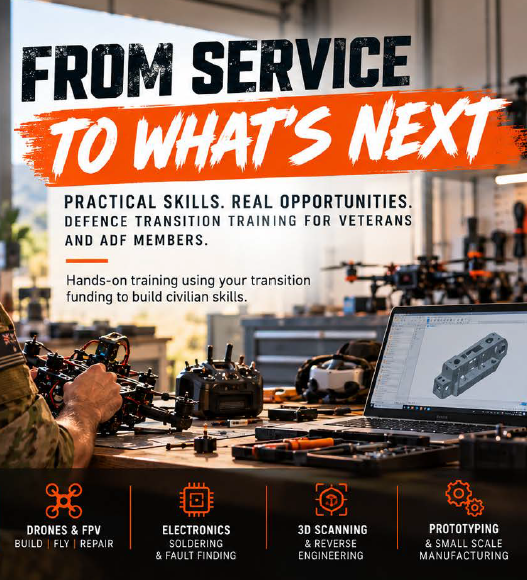
That's why Rising Sun FPV offers practical, hands-on training across 3D printing, CAD, drones, FPV systems, electronics, manufacturing, prototyping and digital fabrication.
And depending on your individual circumstances and transition plan, some of that training may be able to form part of your Defence-funded transition training.
What Defence Transition Funding Is Available?
The Australian Defence Force provides a range of support to members transitioning from military service into civilian life through the Defence Force Transition Program (DFTP).
One of these supports is the Career Transition Training Program.
Defence currently states that the program can provide a financial contribution of up to $5,320 towards approved training and upskilling aligned with a member's post-transition employment or meaningful-engagement goals.
Transition support through the DFTP can also remain accessible for up to 24 months after separation, depending on individual circumstances and eligibility.
The important part is that transition assistance is needs-based. What is approved for one member may not necessarily be approved for another.
Training should therefore be discussed with your Transition Support Officer and approved before committing to or commencing the training.
So What Could You Learn at Rising Sun FPV?
This is where things get interesting.
Modern manufacturing and technology covers a huge range of skills, and you don't necessarily need to leave Defence knowing exactly what civilian job title you want.
You might know that you enjoy fixing things.
You might enjoy electronics.
You might have spent years working around aircraft, vehicles, communications equipment or technical systems.
Maybe you've always wanted to learn CAD.
Maybe you've bought a 3D printer but want to move beyond downloading files from the internet.
Maybe drones and remotely piloted systems are the direction you want to take.
Or perhaps your long-term goal is to establish a small manufacturing, prototyping or technology business of your own.
Rising Sun FPV can develop training around those goals.
3D Printing and Additive Manufacturing
3D printing is no longer simply a hobby technology.
Additive manufacturing is being used for prototyping, engineering, education, defence, manufacturing, replacement components, tooling, jigs, fixtures, modelling and low-volume production.
Our training can start with someone who has never touched a 3D printer before.
We can cover:
- Introduction to FDM 3D printing
- Setting up and operating a 3D printer
- Slicing software
- Preparing files for manufacture
- PLA, PETG, ASA, TPU and engineering materials
- Supports and model orientation
- Strength and print optimisation
- Troubleshooting failed prints
- Printer maintenance
- Nozzle and hotend maintenance
- Calibration
- Advanced slicing
- Multi-material and multi-colour printing
- Large-format printing
- Resin/SLA printing
- Post-processing
- Production workflows
The objective isn't simply to show you where the Print button is.
We want you to understand the process well enough to diagnose problems, make informed decisions and operate the equipment independently.
CAD and 3D Design
Being able to operate a printer is useful.
Being able to design the thing you need to print takes that capability considerably further.
CAD skills can be applied across engineering, manufacturing, prototyping, automotive, defence, construction, product development, fabrication and countless other industries.
Rising Sun FPV can provide introductory through to advanced CAD training covering areas such as:
Basic CAD
Learn how to navigate CAD software, understand sketches, dimensions, constraints, extrusions, cuts and other fundamental tools.
Intermediate CAD
Move into assemblies, more complex geometry, designing around real-world measurements and creating functional components.
Design for 3D Printing
Learn why something that looks perfect on a computer may not necessarily manufacture well.
This can include tolerances, clearances, wall thickness, orientation, support requirements, material selection and designing around the limitations of additive manufacturing.
Reverse Engineering and 3D Scanning
Learn how physical objects can be measured, scanned and recreated digitally for modification, reproduction or integration into new designs.
These skills can be particularly useful for veterans with mechanical, technical or engineering backgrounds who already understand how components work but want to develop the digital skills to manufacture them.
Drone and FPV Training
Drones are another rapidly developing technology area with applications well beyond recreational flying.
Rising Sun FPV has extensive experience with FPV systems, custom drones, electronics, flight controllers, radio systems and drone repair.
Training can be tailored around areas such as:
- Introduction to drones and FPV
- Drone components and systems
- Flight controllers
- Motors and ESCs
- Radio systems
- Video transmission systems
- Analogue, DJI and HDZero FPV systems
- Batteries and power systems
- Wiring
- Soldering
- Building an FPV drone
- Configuring flight controllers
- Betaflight
- INAV
- ArduPilot
- Troubleshooting
- Repair and maintenance
- Component replacement
- Bench testing
- Safe workshop practices
For somebody coming from a technical Defence background, many of the underlying concepts may already feel familiar. The training can help translate that experience into civilian drone and remotely piloted technology.
Electronics and Soldering
Sometimes the most valuable skill is also one of the simplest.
Knowing how to solder properly and diagnose basic electronics opens the door to repair, prototyping, drones, robotics, RC systems and electronics projects.
We can provide hands-on instruction covering soldering equipment, wire preparation, connectors, PCB soldering, component replacement, continuity testing, fault finding and general workshop practices.
Rather than practising entirely in theory, the focus is on actually getting onto the bench and developing the physical skills.
3D Scanning and Reverse Engineering
Have a physical component but no CAD file?
That is where 3D scanning and reverse engineering come into play.
Training can introduce the process of capturing physical geometry and converting it into useful digital information.
From there, you can learn how scan data can be cleaned, measured and used as a reference for CAD modelling and reproduction.
Combined with CAD and additive manufacturing, this creates a powerful workflow:
Physical Component → Scan → CAD → Prototype → Test → Manufacture
That's a workflow with applications across a large number of civilian industries.
Prototyping and Small-Scale Manufacturing
For members interested in manufacturing or eventually starting their own business, training can also be structured around the complete process of turning an idea into a physical product.
That might involve:
Idea → CAD → Prototype → Test → Revise → Manufacture → Finish
Depending on the training objectives, this can introduce additive manufacturing, CNC machining, laser equipment, mould making, resin casting and other workshop processes.
The aim is to understand how different manufacturing technologies can complement one another rather than treating each machine as an isolated skill.
Silicone Moulding and Resin Casting
Digital manufacturing doesn't always finish at the 3D printer.
A printed master can become the beginning of an entirely different manufacturing process.
Training can cover the fundamentals of producing masters, preparing mould boxes, understanding silicone mould-making processes, mixing and pouring materials, demoulding, resin casting and finishing.
This is particularly useful for anyone considering product development, model making, prop manufacturing, reproduction components or small production runs.
Laser and Digital Fabrication
Depending on the member's training objectives, there may also be opportunities to develop knowledge around laser and other digital fabrication processes.
Understanding the differences between additive manufacturing, subtractive manufacturing and laser-based processes helps build a broader understanding of modern small-scale manufacturing.
Instead of asking:
"How do I make this on a 3D printer?"
you start asking:
"What is the best manufacturing process for this component?"
That is a much more valuable skill.
Training Can Be Built Around Your Goal
One of the advantages of working with Rising Sun FPV is that training doesn't necessarily need to be a generic, one-size-fits-all course.
A member interested in drone technology is going to need a very different training pathway from someone interested in CAD and additive manufacturing.
Someone planning to work in a technical role might want:
CAD + 3D Printing + Electronics + Prototyping
Another member might want:
FPV + Soldering + Drone Building + Flight Controller Configuration + Troubleshooting
Someone interested in advanced manufacturing might instead look at:
CAD + 3D Scanning + Additive Manufacturing + CNC + Laser + Prototyping
We can discuss what you're trying to achieve and develop an appropriate training proposal that you can take to your Transition Support Officer for consideration.
What Can't Transition Funding Be Used For?
This is also important.
Defence's current rules state that Career Transition Training funding is intended for approved training and does not cover items such as books, equipment or materials, conferences or workshops, or professional/trade-union memberships.
That means transition funding shouldn't be viewed as "$5,320 to spend on equipment."
For example, you generally shouldn't expect to use the Career Transition Training benefit simply to purchase yourself a 3D printer, drone, laptop or other equipment.
The focus is the training and skills development associated with your post-transition goals.
Approval needs to come from Defence, and your individual circumstances matter.
You Don't Have to Wait Until Your Last Day
Transition planning is something worth starting early.
Defence provides Transition Support Officers who work with members to establish post-transition goals and develop an individual transition plan.
There are also other supports available, including career transition coaching, job-search preparation, recognition of military skills and, depending on circumstances, assistance with training, financial advice and some travel associated with approved training.
Your existing military skills may also be able to be formally recognised through Defence's transition and civil recognition processes.
The first step should therefore be talking with your Transition Support Officer about what you want your life after Defence to look like.
You've Already Got More Transferable Skills Than You Think
One thing we regularly see with Defence members is that they underestimate how much knowledge they already have.
Problem solving.
Working from procedures.
Fault finding.
Technical documentation.
Equipment maintenance.
Working safely.
Planning.
Logistics.
Communications.
Training others.
Working under pressure.
Taking responsibility for equipment.
Learning complicated systems.
Those skills don't disappear when you hand your uniform back.
Sometimes what is missing is simply the civilian qualification, technology or practical skill that connects your military experience to the next industry.
That's where targeted transition training can make a genuine difference.
Veteran-Owned. Practical Training. Real Equipment.
Rising Sun FPV isn't a classroom that happens to have a 3D printer sitting in the corner.
We are a working drone, additive manufacturing, prototyping, repair and digital fabrication business.
Our workshop works with equipment and technologies including FDM and resin 3D printers, large-format additive manufacturing, CAD, 3D scanning, FPV drones, electronics, CNC equipment, laser systems, silicone moulding and resin casting.
The focus of our training is practical.
We want you operating equipment.
We want you designing things.
We want you diagnosing faults.
We want you understanding why something failed rather than simply being told to press another button.
Most importantly, we want you leaving with skills you can continue developing after the training is finished.
Thinking About Leaving Defence?
If you're currently serving, approaching transition, or have recently transitioned from the ADF, come and have a chat with the team at Rising Sun FPV.
Tell us where you've come from, what interests you and where you're thinking about going next.
Whether that's additive manufacturing, CAD, drones, electronics, prototyping or simply exploring what modern digital manufacturing actually involves, we can discuss potential training pathways and prepare information for you to take back to your Transition Support Officer.
Defence currently advises that the Defence Force Transition Program can be accessed on a needs basis for up to 24 months following transition, and approved Career Transition Training may provide up to $5,320 towards vocational or educational training aligned with your post-transition employment or meaningful-engagement goals.
Training approval must be obtained through Defence, and eligibility and funding will depend on your individual circumstances and transition plan.
Your military career might be finishing. Your technical career doesn't have to be.
Talk to Rising Sun FPV about Defence Transition Training
If you'd like to explore a tailored training pathway in 3D printing, CAD, drones, FPV, electronics, 3D scanning, prototyping or digital manufacturing, get in touch with Rising Sun FPV and tell us what you'd like to achieve.
We can help you work out what training may suit your goals and provide a training proposal for you to discuss with your Defence Transition Support Officer.