
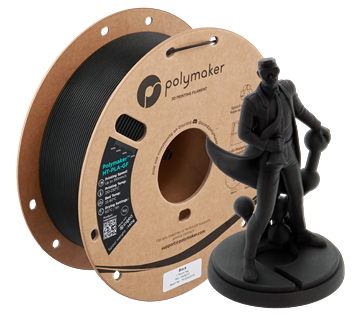
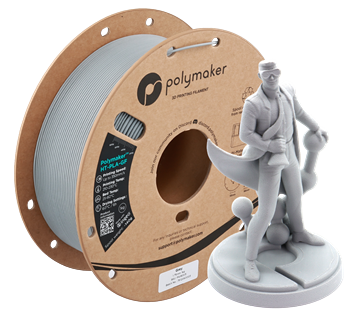


Secure checkout
Dispatch
Description

Glass-fiber reinforced HT-PLA for the workshop with heat stability up to 130°C right off the printer and high HDT after annealing.
Not everyone has the capability to print in high temperature filaments such as PETG, ASA or Nylon and some hobbyists and educators choose to only print in PLA. As we all know - PLA has always deformed in the heat, limiting the applications for these users.
Polymaker™ HT-PLA-GF offers improved heat resistance after annealing while maintaining PLA's ease of printing. It’s ideal for applications requiring high thermal stability, withstanding mechanical stress and temperatures up to 100°C. The high softening temperature is achieved before annealing, but the heat deflection temperature is achieved through a very short annealing process (30 minutes at 100°C).
Don't need heat deflection temperature? Check out the standard Polymaker™ HT-PLA or Polymaker™ Gradient HT-PLA
Features
- High Heat Stability - Polymaker™ HT-PLA-GF delivers high heat stability up to 130°C right off the printer, no post-processing required. Heat stability refers to the ability to remain dimensionally stable at elevated temperatures under no or minimal external load other than its own weight.
- Good Heat Resistance - For applications that could face some mechanical force at elivated temperature, heat deflection temperature (HDT) is important. Polymaker™ HT-PLA-GF has been optimized for annealing so you can increase the HDT of your models, it's as easy as putting them in an oven at 100°C for 30 minutes. The glass-fiber reinforcement in Polymaker™ HT-PLA-GF significantly minimizes shrinkage during annealing, an issue that un-reinforced HT-PLA materials can face. With a high heat deflection temperature, Polymaker™ HT-PLA-GF is the perfect choice for power tool accessories, custom PC parts, heat shields and fan ducts.
- Glass Fiber Reinforced - Polymaker™ HT-PLA-GF is glass fiber reinforced which significantly boosts tensile strength and stiffness for a wide range of functional applications that also require heat stability or heat resistance. The glass fibers also reduce "mechanical creep", a property that is also further reduced by annealing. It is worth noting that HT-PLA-GF exhibits lower z-axis layer adhesion compared to normal PLA which is common for glass-fiber reinforced materials.
- High Speed Capable - Polymaker™ HT-PLA-GF is based on a high-speed PLA formula, enabling high speed printing up to 350mm/s and compatibility with a wide range of 1.75mm diameter machines. An enclosure is not needed for this high temp filament! You simply need a wear resistant nozzle due to the addition of glass-fibers.
- No Compromise - At its core Polymaker™ HT-PLA-GF is a PLA-based multiphase composite, built around NatureWorks PLA so you can expect similar chemical resistance and the same low shrinkage rate as normal PLA. Combining Polymakers innovative R&D technologies, compounding and extrusion systems with Natureworks Ingeo® resins produces a reliable 3D printing filament to print beautiful and accurate models.
Polymaker PLA Comparison
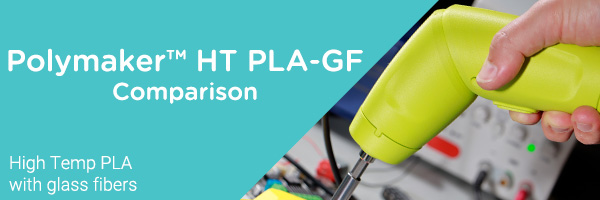
| Polymaker™ HT-PLA-GF | PolyLite™ PLA | PolyLite™ PLA Pro | PolyLite™ PETG | PolyLite™ ABS | |
| Type of PLA | High Temp PLA-GF | PLA | PLA+ | PETG | ABS |
| Description | Glass Fiber Reinforced High Temperature PLA | High Quality PLA | High quality PLA with improved impact strength. | High quality PETG | Durable ABS |
| Nozzle Temperature Range | 210°C - 230°C | 190°C - 230°C | 190°C - 220°C | 230°C - 260°C | 245°C - 265°C |
| Rigidity Young's Modulus (X-Y) |
3,793 MPa | 3,426 MPa | 2,932 MPa | 2,116 MPa | 2,246 MPa |
| Tensile Strength (X-Y) |
50 MPa | 52.3 MPa | 49.8 MPa | 50.8 MPa | 33.4 MPa |
| Impact Strength (X-Y) |
5.31 kJ/m2 | 3.3 kJ/m2 | 17.1 kJ/m2 | 2.6 kJ/m2 | 18 kJ/m2 |
| Speed | Up to 350mm/s | Up to 200mm/s | Up to 200mm/s | Up to 100mm/s | Up to 200mm/s |
| Glass Transition Temperature | 59.76°C | 61°C | 62°C | 81°C | 101°C |
| Vicat Softening Temperature | 145.2°C (as printed) 148.3°C (annealed) |
63°C | 63°C | 84°C | 104°C |
| Heat Deflection Temperature (0.45 MPa) |
75°C (as printed) 114.7°C (annealed) |
60°C | 59°C | 78°C | 100°C |
| Heat Deflection Temperature (1.8 MPa) |
59.7°C (as printed) 84°C (annealed) |
58°C | 58°C | 75°C | 98°C |
| Special Feature | - Glass fibers enable annealing to improve heat deflection temperature. - Base formula offers high softening temperature right of the printer. Great for parts that will be exposed to high temperatures without force. - Based on high-speed PLA formula for high speed printing. |
- Best layer adhesion. - Highest rigidity & strength. - Available in both opaque colours and natural (translucent) colour. |
- Combines best of both worlds; high rigidity & strength of PLA with superior impact resistance. - Less glossy than PolyLite™ PLA. |
- Combines good printability, mechanical properties & heat resistance with better dimensional stability than ABS, ASA & PC. |
- Less smell than other ABS filaments. |
| Popular with | Ideal for tool accessories, print-farms | General use | General use | Design & functional prototyping. | Design, functional prototyping & manufacturing. |
Data taken from Polymakers Technical Data Sheet and is intended for reference and comparison purposes only. Due to the nature of 3D printing, data should not be used for design specifications or quality control purposes.
Why order from Rising Sun FPV?
• Orders ship out of Townsville, QLD, Australia at 1530.
• Active on Instagram - Tag us or DM us!
• Watch what we are up to on our YouTube Channel!
• Join our Facebook Page for updates and RSFPV news.
• GST Registered.
• Gifts with every order!
• Veteran Owned and Operated
• Defence and Service discounts - Apply Here
• 3D Printing and Custom design – Inquire Here.
• Visit us at our Store and have a yarn.
• Sponsor of Townsville FPVR, Next Level FPV
and the Australian Army Drone Racing Team.
• FPV Drone service, support and repairs.
• Earn points for every $1 spent.
• Buy now and pay later with Zippay, Afterpay and Humm.